Vibration in a skid-mounted compressor package is a system response, not a diagnosis. Excitation may come from the compressor, driver, coupling, gas flow or connected piping. The skid and foundation transmit that excitation, while their stiffness, mass and support conditions influence the measured response.
The point with the highest reading is not necessarily the source. A useful investigation separates the excitation source, its transmission path and the component response before choosing a corrective action.
Why Skid Vibration Is a System-Level Problem
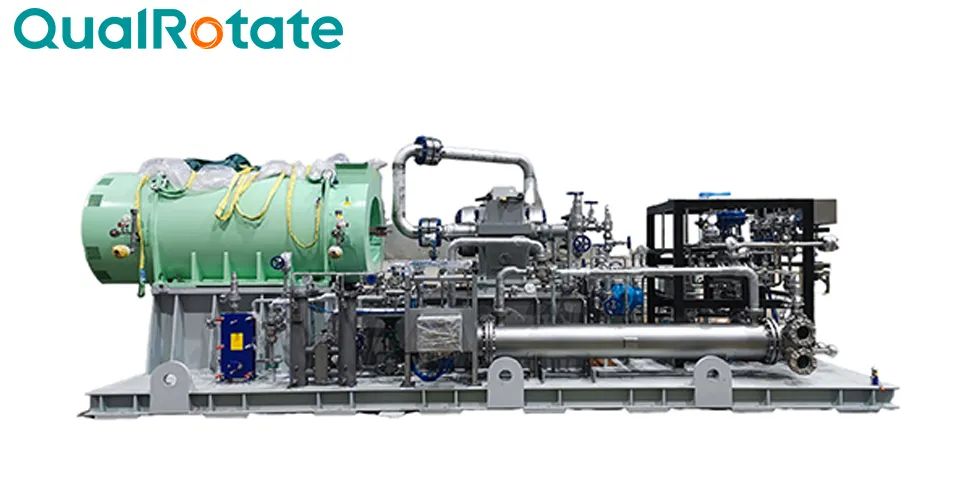
A compressor package places the compressor and driver on a common frame, which transfers loads to the foundation and connects to piping and auxiliary equipment. A vibration reading at one location may therefore reflect excitation generated elsewhere or amplified along the structure.
Separate three questions: what generates the excitation; how it travels through the machine, skid, foundation and piping; and which component responds most strongly under the recorded operating condition. The most visible vibrating part is not automatically the root cause.
QualRotate’s compressor skid package page describes package integration, finite element analysis, vibration-isolation design where required and vibration monitoring. These capabilities should not be interpreted as proof that every project includes the same dynamic analysis. For package-layout context, see the existing guide to compressor skid design. A monitoring system can help identify when a trend changes, but diagnosis still requires the measurements to be interpreted alongside the operating state and package configuration.
Base Frame Stiffness and Structural Resonance
The base frame’s stiffness, mass, support locations and foundation connection influence how the package responds to dynamic forces. If a structural natural frequency is close to an excitation frequency, vibration may be amplified. Local reinforcement should therefore follow an understanding of the load path and structural response, not guesswork. The frame is part of a load path: compressor and driver forces pass through beams, connections, anchors and grout into the foundation. A weakness or discontinuity at any point can alter the response.
Different analyses answer different questions. Static stress analysis evaluates stress and deformation under defined loads; modal analysis estimates natural frequencies and mode shapes; dynamic response analysis evaluates the response to specified excitation. A static finite element stress plot alone does not prove that resonance has been avoided.
A Texas A&M symposium case study examined a 1,500 hp, two-stage, oil-flooded rotary screw compressor in CO2 service—not a centrifugal compressor. Measurements showed high vibration at the frame, compressor, vessel and motor. Spectral analysis identified gas-pulse frequency as the excitation source, while increasing vibration away from the compressor pointed to structural amplification. The skid lacked anchor bolts to the foundation and had limited grout beneath perimeter beams [1].
The reported remediation added six anchor bolts and epoxy grout under primary load-supporting areas; subsequent measurements showed a substantial reduction in frame vibration [1]. The transferable lesson is to examine stiffness, anchoring, grout contact and the complete load path. The specific repair is not a universal prescription for centrifugal packages.
How Driver Alignment Influences Package Vibration
The driver and compressor are connected through a coupling, so their relative shaft positions matter. Angular or parallel misalignment can introduce additional forces, but vibration alone does not prove that alignment is the cause.
Cold alignment is only one part of the assessment. The driver, casing, support structure and piping can move as temperatures change, so the intended operating alignment may need to account for thermal growth. Massey and Campbell discuss shaft-centerline measurement, thermal movement and alignment tolerance selection [3].
Review alignment records, coupling condition, soft-foot checks and base condition. Compare cold and expected operating conditions where the engineering method allows it. Do not insert a universal tolerance: allowable values depend on the machine, coupling, speed, temperature and manufacturer requirements. After realignment or component replacement, the team should also confirm that connected pipework and supports have not introduced a new constraint.
Piping Loads and Their Effects on Compressor Packages
Piping affects a package through two distinct mechanisms. Mechanical loading can arise from pipe weight, thermal expansion, support movement or installation strain. Dynamic excitation can arise when gas pressure pulsations excite vibration in the pipework.
Mechanical loads require review of pipe supports, thermal movement and nozzle loads. Dynamic vibration requires attention to excitation frequencies, acoustic behaviour, pipe natural frequencies and measured response. Calling both mechanisms simply “high piping pressure” hides the engineering distinction. A support that is too rigid, incorrectly located or unable to accommodate thermal movement can transfer additional loads to the package. Conversely, changing a support without checking dynamic behaviour may simply move the vibration problem to another location.
A Texas A&M study explains that impeller-blade interactions can generate blade-passing-frequency pulsations, typically above 1 kHz, which may excite vibration in a centrifugal compressor and adjacent piping. It reports a chemical-plant case involving pipe fracture; case-specific countermeasures included diffuser changes, increased pipe wall thickness and an expansion joint, followed by on-site measurement [2]. These measures are not a standard solution for every package.
From Vibration Symptoms to Engineering Verification
Start by recording the operating state: speed, load, flow, pressure and relevant temperatures. Define repeatable measurement points on the compressor, driver, frame, foundation and connected piping. Readings from different conditions or locations should not be compared as if they were equivalent. Record sensor locations, directions and mounting method as well as the machine condition. This makes repeat measurements more useful and helps distinguish a real change from a difference in measurement setup.
Review overall vibration and frequency content. Compare observed frequencies with running speed and plausible excitation sources; check phase and relative movement where the method supports it. Inspect the coupling, alignment, anchors, grout, frame supports, foundation and pipe supports against the working hypothesis. A frequency peak is a clue rather than a diagnosis: the same frequency may be associated with more than one physical mechanism, so it should be checked against operating speed, process conditions and the location where it is measured.
Then verify the corrective action. Document what changed and repeat measurements under comparable conditions. If the source is a piping load, frame reinforcement may not solve it; if the response is structural amplification, replacing compressor internals may leave the support problem untouched. Where an existing machine or package needs engineering changes, QualRotate’s compressor retrofit service can be considered.
| Observed pattern | Questions to verify before selecting an action |
| High vibration across several components | Does the frequency content point to one common excitation source or several sources? |
| Vibration increases away from the compressor | Could the frame, foundation or support arrangement be amplifying the response? |
| Vibration is concentrated in piping | Is the mechanism mechanical loading, acoustic pulsation, a local pipe mode or a combination? |
| Vibration changes with speed or load | Does it track a rotating order, gas-pulsation frequency or structural response range? |
| Vibration changes after maintenance | Were alignment, supports, anchors, grout or coupling conditions altered? |
Frequently Asked Questions
Does skid vibration always mean rotor damage?
No. The source may be the driver, coupling, gas pulsation, piping or support system. Compare measurements across the machine train before concluding that internal damage is responsible.
Can static finite element analysis rule out resonance?
No. Static analysis evaluates stress and deformation. Modal analysis estimates natural frequencies and mode shapes; dynamic assessment and measurement are needed to evaluate operating response.
Can shaft misalignment cause vibration?
Yes, but vibration alone does not prove misalignment. Review alignment records, thermal growth, coupling condition and other possible excitation sources.
Why include connected piping in the investigation?
Piping can transmit mechanical loads or develop a dynamic response to pressure pulsations. Its vibration may not match the highest casing reading.
Will adding grout and anchor bolts always solve skid vibration?
No. The result depends on the excitation source, frame, foundation, contact and operating configuration. The published Texas A&M case involved a specific rotary screw compressor, not a universal repair method.
References
Miller, Z. D., Matthews-Ewald, C. R., Gerdes, K., & Schell, E. F. (2024). Existing compressor skid vibration: Anchoring & grouting upgrade [Conference case-study presentation]. Turbomachinery & Pump Symposium. Texas A&M University, OAKTrust.
Hirata, D., Nekomoto, Y., Ibrahim, F., Nakaniwa, A., van Beek, P., & Frediani, L. (2022). High frequency acoustic excitation in centrifugal compressor and adjacent piping vibration. In Proceedings of the 3rd Asia Turbomachinery & Pump Symposium. Turbomachinery Laboratory, Texas A&M Engineering Experiment Station.
Massey, C. R., & Campbell, A. J. (1992). Reverse alignment—Understanding centerline measurement. In Proceedings of the Twenty-First Turbomachinery Symposium (pp. 189–195). Turbomachinery Laboratory, Texas A&M University.
QualRotate Machinery. (n.d.). Skid-mounted compressor package.
QualRotate Machinery. (2026, March 16). Skid-mounted compressor package: The “hardcore foundation” of industrial compression.
QualRotate Machinery. (n.d.). Compressor complete unit retrofit.

 English
 中文